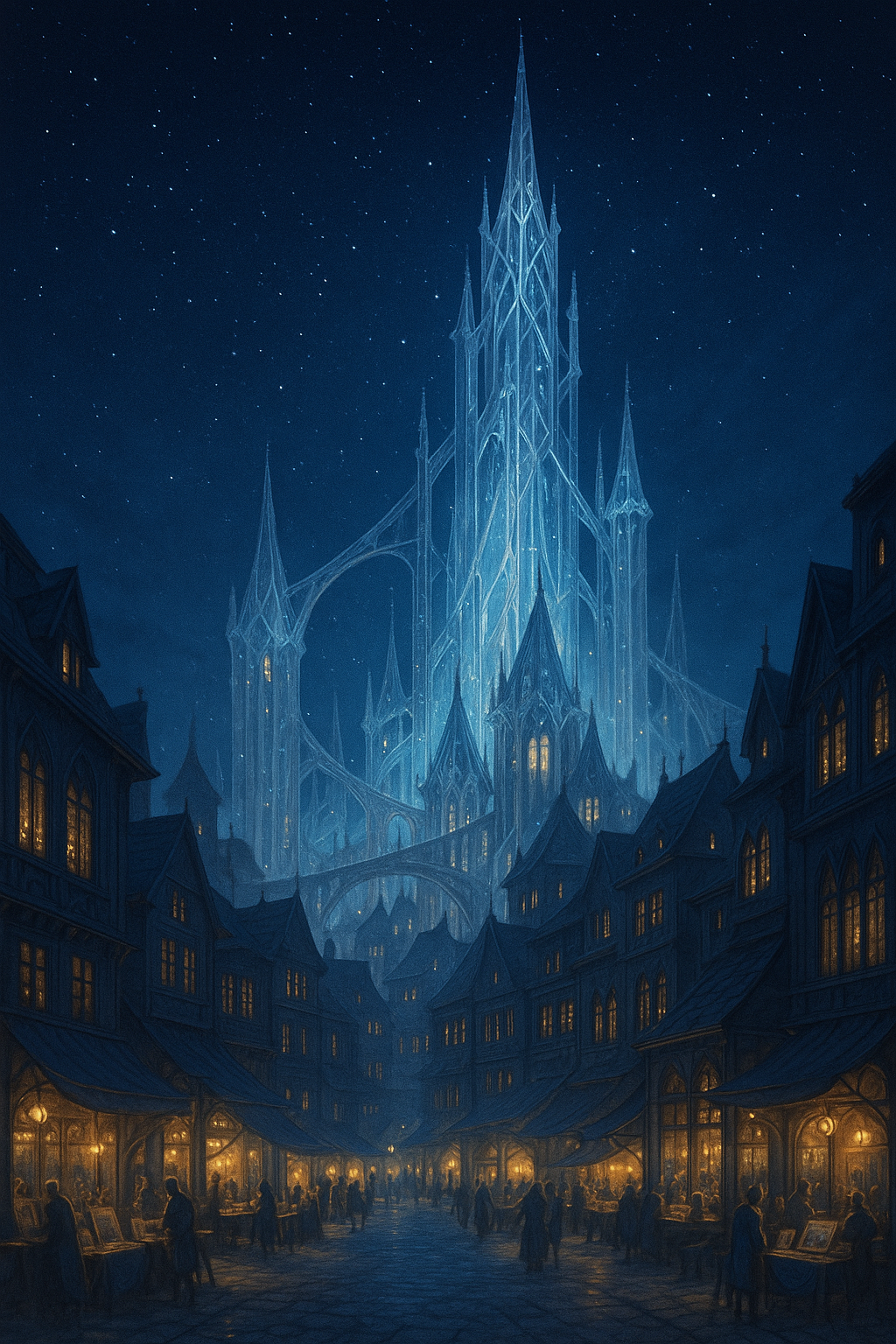
Less than a day’s ride from Lindral Citadel, the citadel of Astravayne crowns the eastern rise like a shard of captured sky — all crystalline towers and latticed bridges, suspended between discipline and dreaming. Though smaller than the capital, its silhouette gleams by day and glows by night, visible even from Lindral’s highest balconies. Some say you can tell the health of Astravayne’s arcane grid by the clarity of its glow: a pale, steady pulse like a held breath.
The city is both seat and sanctuary of the House of Spires— a lineage famed for magical jurisprudence and the cold governance of arcane law. Their most prominent bloodline, Illistar, lends gravity to Astravayne’s rulings, but the House of Spires as a whole stretches beyond blood or branch. Magic here is not simply power — it is governance, structure, and sacred inheritance.
At the city’s centre rises the Sanctum Arcanum, a towering, sunless spire whose foundations burrow deeper than any map dares trace. Within its shadow, arcane law is not only debated — it is forged. These rulings shape what is permissible for every magic-user in Gildraen. Some shape the realm. Others are never spoken of again.
And yet, Astravayne is no dead thing of ledgers and laws.
When dusk falls, the city exhales. Rune-lanterns bloom across its high bridges, casting stars upon the cobbles. Artists set up canvas stalls in temple gardens, coffee houses fill with murmured theory and stringed music, and charm-crafters leave flickering sigils of their wares trailing in the air like scent. The magic that by day watches and weighs, by night sings and sways.
Astravayne is a place of contrasts: of grandeur and restraint, of structure and soul. Its people are precise, but not unfeeling; proud, but not unkind. Every citizen knows they walk through a living lattice of power — and those who stay learn to listen for its quiet rhythms.