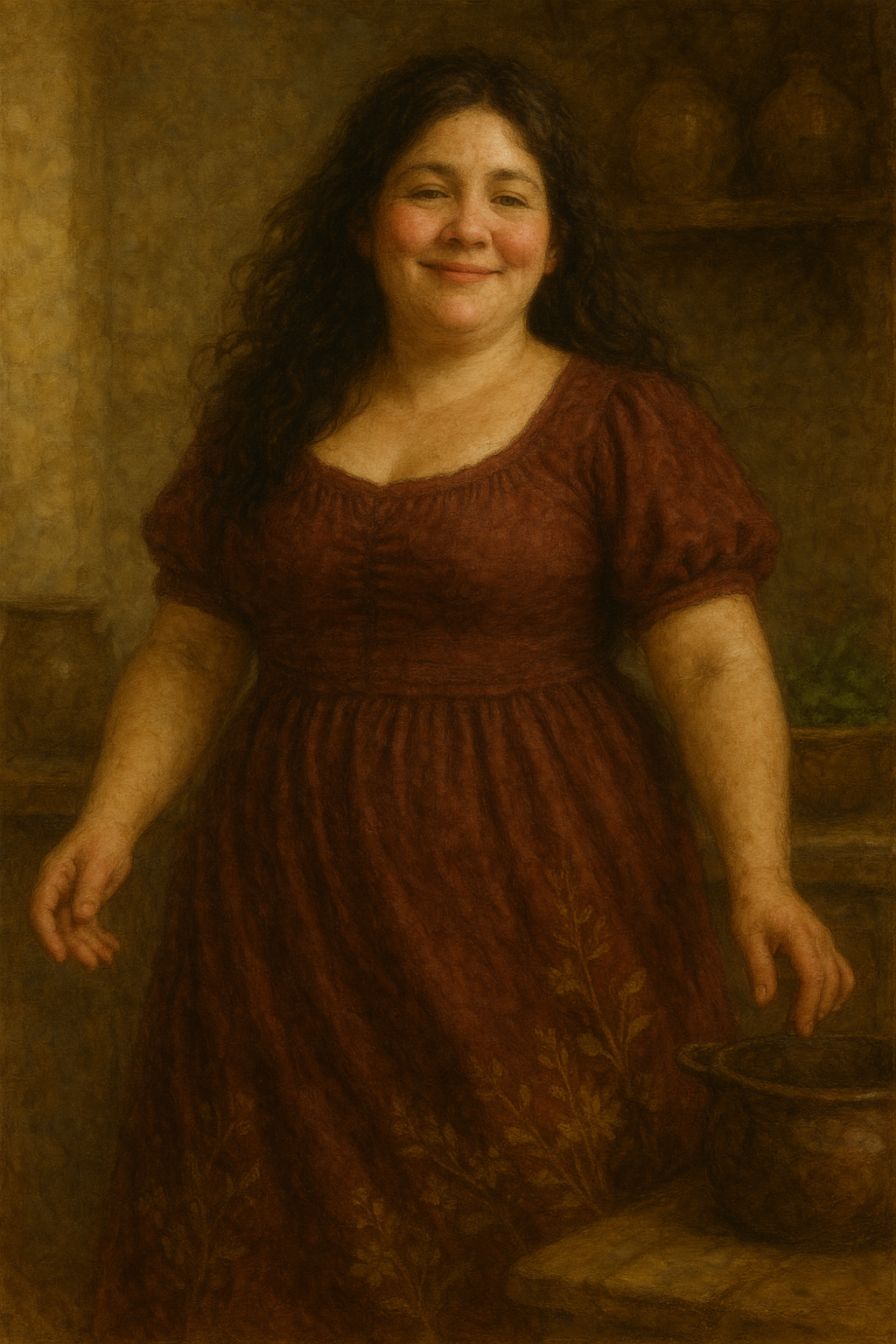
Sorrel was named for the red-veined leaf — and she lived it: green through and through, but with a heart that blushed through everything she did. Her presence was like warm bread and birdsong. She wore love openly and simply, without needing thanks or grandeur.
She wore bold, grounded colours: burgundy, ochre, deep green, black. Dresses ruched at the top, wide and flowing below, often stitched with flowers by hand, the thread pulling the garden in with her.
She lived on the land and from it. She grew what she cooked and cooked what she grew, humming tuneless melodies while bending at the waist to pluck greens straight into her apron pocket. Her hands were always doing: shelling peas, rubbing herbs, tucking hair behind a flushed cheek.
And when the apron came off — her hair came down too: black, long to the elbows, a little wild, and with it came the scent of crushed mint and fennel, a smile like laughter waiting to burst, the feeling of a gathering just about to begin. She wasn’t dusk. She was the start of the party — hands in the dough, music starting up, warmth spilling from the door.
She loved without condition. Everyone felt it. But for Orris, it was the soil in which he rooted. She was his why. She saw people whole and made them feel that being seen was safety, not risk.
Harn depended on her more than he ever said. Sorrel was a song to him — not a distraction from his tension but a counter-melody. He only let himself be vulnerable when they were alone, though Orris and his sister Willa saw the softening too. Sorrel never flinched from Harn’s brooding. She met it with tea, laughter, and simple truths.

When a child cried — hers, someone else’s, no matter — Sorrel never hushed or corrected. She scooped them up, held them cheek-to-cheek, and hummed like she was stirring something warm. No words. Just breath and closeness and rhythm. It was as if she borrowed calm from the garden and passed it through her skin.
She smelled like bay and baked apples, and her lap was always just the right temperature. Even when she was busy — especially then — she’d pause, tie off a braid of onions, and gather the child in.
“We’ll cry it out together, then,” she’d say softly. And sometimes she did. Just a little.
She had no magic, and yet… she didn’t need it. Her presence was tuning. She was one of the 10% — those who live in such honest alignment that they brighten the Hum without even knowing it.
Orris was drawn to the Evergild gardens not out of ambition, but because growing for the kitchen was how he had first learned love.
Leave a Reply