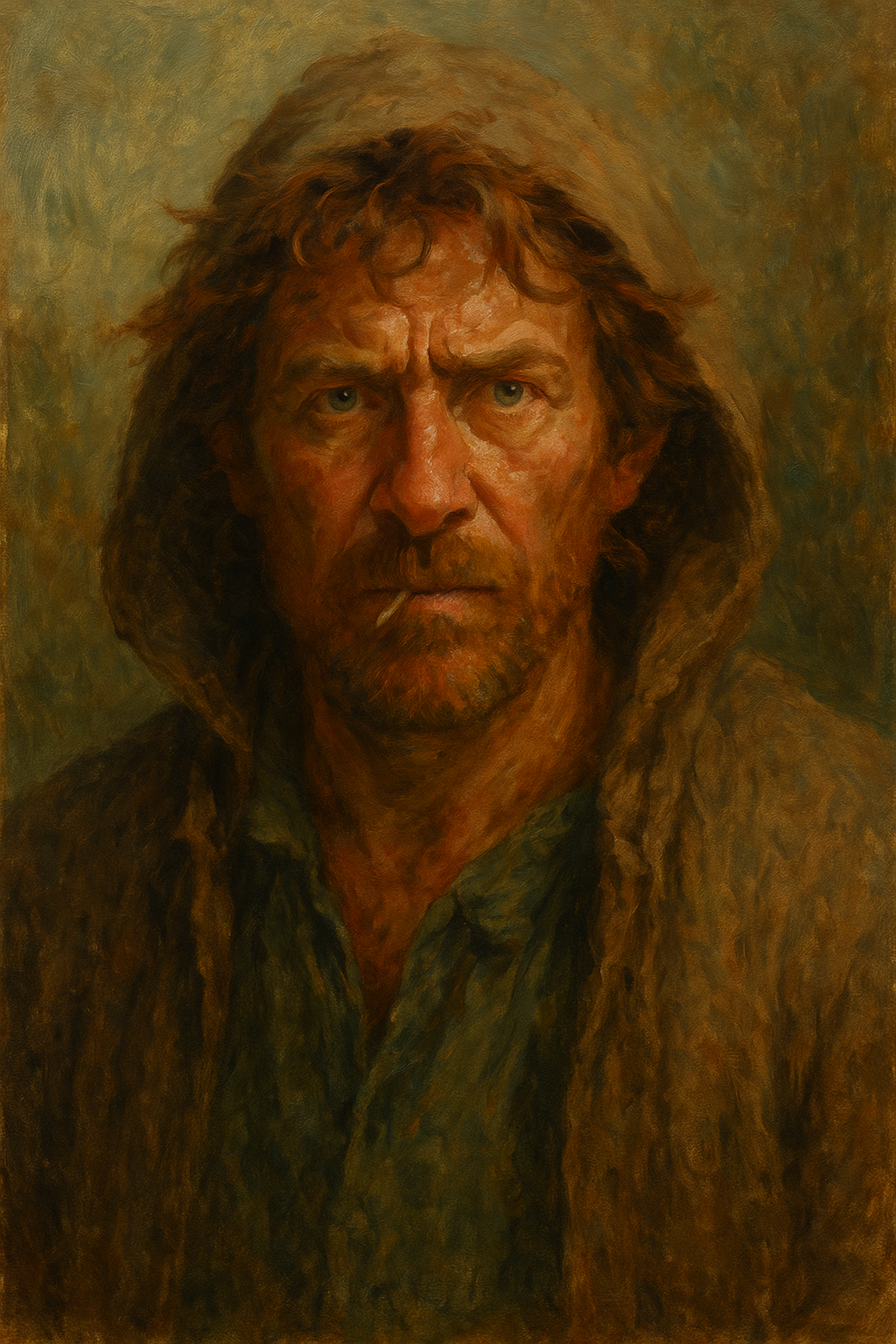
Origin story
Tauren Foss didn’t walk the land the way his brother Harn did. Harn stood still, watched, listened for shifts in the hum. Tauren moved — not in restlessness, but in rhythm. He mapped, turned soil, pressed patterns into notebooks. He didn’t inherit his mother’s Seeing, not exactly, but something of her understanding of threads lived in him — only he tracked them in how water pooled at the base of a slope, or how certain herbs flowered earlier when geese nested close by.
He was the one who healed Elgan Hollow, the grain-keeper’s daughter, after she’d lain near-dead for weeks. He brewed a tincture of marsh thistle, black willow, and hornbeam fungus, dosed gently over days, always watching. When she stood unaided, word spread fast. That’s how the Verdant Order of the House of Beasts heard of him — first with curiosity, then intent.
They offered him a contract, and Tauren said yes, not because he craved status or coin, but because he saw a doorway. He believed that within the machinery of the Evergild, he might be a small lever — a way to keep old growing knowledge alive inside systems that were flattening everything.
He thought Harn would understand.
But Harn only saw the warp in the hum, the colour wrong at the edges, the sense that something sacred was being twisted. And Tauren’s genuine conviction — that this was salvageable, that it needed infiltrating rather than avoiding — sounded to Harn like betrayal.
They didn’t fight. But they stopped speaking plainly. A silence stretched between them like an old rope — tight, weather-worn, unbroken but brittle.
Tauren’s teaching came in part from Stellan. She didn’t favour him, not outwardly, but she saw how he worked, and taught him the way she taught — by asking better questions.
“You’re trying to change the plant,” she said once, watching him mix soil.
“What if you ask it what it wants, first?”
His essence is restless and vital. It energizes, balances, sharpens the spark.
He’s eccentric; not to be strange, but because he’s propelled — by curiosity, by a sense that things can be improved if only you keep tugging at the thread long enough. He talks fast when he’s excited, forgets people are listening, interrupts himself, and sometimes forgets to eat. He chews stems while thinking. Scratches plant diagrams on walls when no paper’s to hand. He seems scattered — until you realise every dot connects if you stand far enough back.
He probably startled the Evergild when they recruited him. Expected a mild-mannered hedge-herbalist, got a wild-eyed soil-puller with fennel behind his ears and a dozen half-labelled tinctures hanging from his belt.
He looked roguish to Evergild sensibilities — scruffy cuffs, soft boots, always with a pocket full of dried leaves or seedpods. But he spoke in a way that was hard to ignore. And his plots flourished. His experiments didn’t always work, but they always taught him something.
When he brought Orris into the gardens — a quiet boy with his father’s gentleness and his mother’s presence — he thought he was giving him a gift.
“He’ll learn more here,” he told Harn.
“Things you can’t teach with just ditchwater and duck eggs.”
But Harn didn’t speak to him after that. Not really.
The Hum, As He Feels It
Tauren doesn’t need stillness to sense the Hum. He finds it in flow — in growth, in flux, in life alive and unashamed. Where others quiet their minds to listen, he opens his whole being to the surge. When he’s deep in the current, he throws his hands up like a conductor at the crescendo and shouts:
“Oh!”
Not with joy, not with surprise, but with reverence. Not smiling. Revealed. Known.
His Work for the Evergild
Tauren worked from within the Everglade Annex, one of the smaller, older cultivation grounds of the House of Beasts — a tiered wetland garden built into an ancient embankment. He helped revive rare species, balanced pollination cycles, and created tinctures that the Order hadn’t seen in generations.
But he had a habit of asking for what he shouldn’t.
“If I had true fen bogbean, I could stabilise this hum-rot overnight.”
“The sweet sedge from the lower driftline would bind that fever without side-thought.”
“You have featherleaf — I know you do.”
They ignored him, until they didn’t. When enough nobles owed him their voice, their memory, or their conviction, they gave him partial access to the seed-vaults.
To him, the vaults are tombs — full of hope sealed off from the world. Seeds, to Tauren, are meant to be in motion. Meant to feel the weather, to fail, to change. He would leave artifacts down there as a kind of protest, a protection or a gift for the seeds. Smooth stones placed exactly, a spider, a handful of fresh grass.
The Wild Garden
It’s said Tauren kept a walled grove just beyond the jurisdiction of the House of Beasts, technically off the books, but still subtly protected by those who owed him their second chances. He bred new cultivars there — hybrids no one else would dare try. Some say the soil itself was laced with hum. Some say it wasn’t soil at all, but something older.
He worked with intention, not wildness. But intention that didn’t ask permission.
The Evergild knew. They pretended not to.
Orris Foss
When Orris joins him in the garden, Tauren doesn’t teach so much as include. He trusts him to prune what’s not explained. Orris is quieter, steadier. Inherits his father’s hush and his mother’s musical brightness. Tauren sees in him not a successor, but a balance.
But Orris feels something wrong inside the Evergild walls. A tug. A warping of the Hum — like sound that won’t resolve into harmony. A sickly brightness. It isn’t Tauren’s work. It’s something in the structure itself.
That tension sits inside him like a note held too long. Eventually, he steps away. Grows quieter. And then — he meets someone. And then — Lowen.
His Legacy
Tauren didn’t write books. But people still quote him:
“A plant tells you what it is. All you have to do is stop pretending you know already.”
“A plant wants to help. If it won’t, it’s not the right time.”
His students — few and accidental — often became quiet legends in their own right. His herbal grammar still echoes faintly in forgotten corners of the Evergild’s records.
The rogue garden? Maybe it’s still there.
Tended. Or untended. Waiting.
Stellan’s Request
It was years since his father’s passing. Stellan appeared at Tauren’s rented garden in the grey hours, when the sky was one solid cloud and the soil hadn’t warmed yet. He looked up from a bed of young feverfew and didn’t startle. Just said, “Didn’t think you’d come this far in.”
Stellan didn’t sit. She paced the rows instead, walking between the young plants like they might whisper something if she passed close enough. She was older now, but the wind still clung to her like a second cloak.
“You’ve made this place yield,” she said eventually.
Tauren wiped his hands on his trousers, wary, unsure whether it was admiration or accusation.
She looked at him, properly. “I came to ask you something.”
And then she told him—not everything, not the whole thread of her unrest—but something sharp-edged enough to leave a mark. A name. A memory that wouldn’t still, and now the world had bent the wrong way. It was why she stayed away. It was why she disappeared for days at a time when Fennick was still alive.
“I had to carry it alone,” she said. “But now I cannot take the risk.”
She asked Tauren to help. To speak to someone. To use the influence he’d earned, the doors he’d walked through that she never would. Whether he agreed or refused, it changed them both.
It’s a memory Tauren rarely speaks of but still turns over, like a coin he can’t spend.