A region of tangled ridges and braided river ground, shaped by water, root, and time.
A number of small and private Lessae Fae settlements are scattered across the higher ground, each tucked where the water holds back just enough. No single hub, but a scatter of kin-places — each a braid within the Braids.
The Landscape
West of Lindral, where the foothills start to fold rough, the lanes dissolve into broken turf and waterlogged crease. Here, the great River Varelha spills and splits through hollows and raised seams of ground, neither true wetland nor clean highland. The mountains hold sharp to the west, blue-edged and steep, while the low river plains push east.
Tucked against the western bank, where the slope finds just enough height to stay dry above winter floods, the land gathers into long, narrow ridges — the Braids.
It’s no marsh—though you wouldn’t know that until you were halfway through the worst of the approach. It’s not forest, either, though the alders and willows form green walls overhead and the ground speaks with the voice of water.
The ground here runs in narrow, tangled rises. Ancient river terraces. Left-behind earth folded high enough to stay dry when the flood comes, yet sunk low enough to hide from the world.
The land shifts under you. One foot right, you’re on firm earth. A step wide, and it’s moss over nothing—a black suck where the water still remembers how to take back the land. The locals (if they bother to speak of it at all) say the place drinks strangers.
The Settlements
And then—when you’ve crossed enough misery, when the last scrape of your boot leaves the black mud behind—the ground firms. The light shifts.
It’s beautiful here. Wild-clear. Air like running water.
Clusters of wild fruit trees—crabapple, wild pear, bitter cherry, plum and sloe—surround little meadows and soft lawns of wild grass. Springs rise cold and clean between the roots.
As you still and let the air settle, you notice the quiet mark of people. Bee trees, mushroom logs, woven beds of sweet reed and drying herbs.
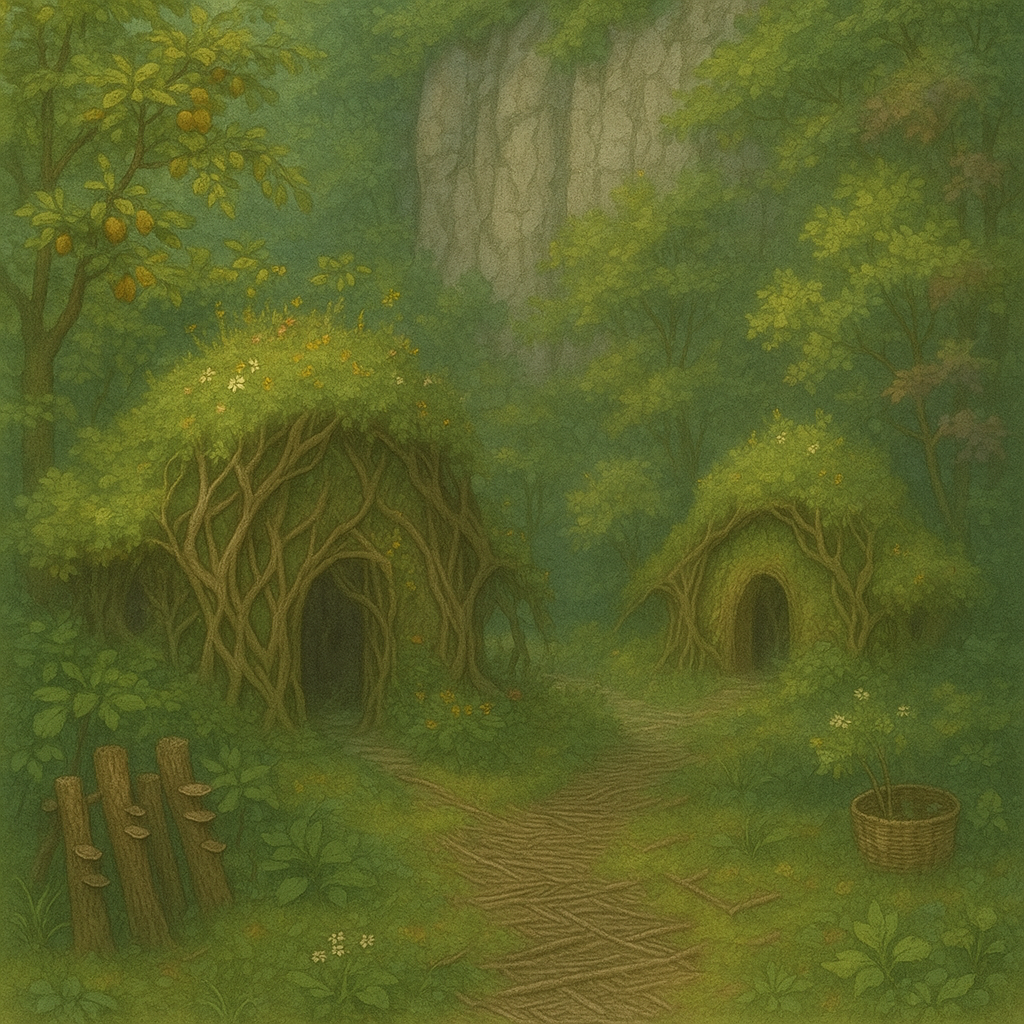
Beneath the trees curled with climbing hartvine and varlberry, the homes grow from living wood and root — patched with daubed wattle and roofed in turf blooming with wildflowers.
It’s a place where the loudness of the world falls away. You hear birds. Water. Wind. Nothing else.
The Approach
The approach is a natural wall of deterrent:
- The Sumps: low, sucky ground where the river once braided through. You step wrong, and the earth takes you to the knee.
- The Hollow Reed: a thicket where sound behaves wrong. You think someone’s behind you. You hear your own breathing a beat behind.
- Bracken Folds: dry-looking, harmless, but dense as a net. Knee-deep, then chest-deep. And full of hidden stones to trip you.
- The Stream Labyrinth: multiple water channels—sometimes only a foot wide, sometimes ten. None run straight. Step in, and some are shallow… others shoulder-deep, dark, and cold.
Locals know to follow the birch markers. Or the line where the blackthorn stops and hawthorn begins. Or the way the air smells different right before the last turn.
Everyone else gets turned around. Or gives up. Or… disappears.
The Lessae in the Braids
Lessae settlements in the Braids are hardly settlements at all. From the outside they appear little more than thickets of wild fruit, coppiced willow, and soft clearings stitched between root and ridge. Homes are grown from living wood and roofed in turf; paths blur into deer-tracks. It looks like wilderness — but it is wilderness slowly and deliberately shaped, curated over decades until people and place are inseparable.
Life here is self-sufficient. Each kin-group tends its own food, forage, stock, tools, and shelter, trading only in quiet surplus. There are no grand guilds or rigid roles, only the shared rhythm of survival. Yet within that rhythm, certain gifts surface: one who reads weather, one who tends bees, one who mends shoes or remembers an old chant. These talents braid through the kin, without hierarchy but with respect.
Their magic is woven into the land much as their dwellings are — not a display of power, but a conversation. The Lessae do not conjure abundance or bend the world to their will. They ask, and the land answers. A root will tell them where it chokes itself. The soil will hint at what it hungers for. A growth-call is repaid with seed left for birds; an unbinding is balanced by planting. Their craft is a practice of reciprocity: to work with the hum of things, not against it.
What emerges is not a hidden city or an enchanted court, but a place where the world feels quietly at ease — where fruit trees scatter blossom across turf, and water runs clear because it has been listened to.